
IB Economics Real world examples (RWE's)
Can supply side policies solve all problems?


Using real world examples (RWE's), evaluate the view that the use of interventionist supply side policies is the most effective way of reducing a country's unemployment! [15]
OR
Using real world examples (RWE's), evaluate the view that the use of interventionist supply side policies is the most effective way of reducing a country's demand pull inflation [15] [15]
What are supply side policies?
Supply-side policies are government actions intended to increase the efficiency and productivity of the economy, thereby shifting the long-run aggregate supply (LRAS) curve to the right. These policies are designed to enhance the productive potential of the economy by increasing the quantity and quality of factors of production, improving market flexibility, and promoting innovation and competition.
PPC curve

LRAS curve

Market based or interventionist supply side policies?
Market-Based Policies: Focus on reducing government intervention and promoting free-market mechanisms to increase economic efficiency. Examples include deregulation, privatization, and tax cuts.
Interventionist Policies: Involve active government intervention to address market failures and provide essential public goods. Examples include investments in education, infrastructure, and research and development.
Market-Based Policies: Aim to enhance efficiency by allowing market forces to operate more freely. For instance, reducing business regulations to lower costs and increase competition.
Interventionist Policies: Aim to directly improve the productive capacity of the economy through government initiatives. For example, building better roads and schools to boost productivity and economic growth.
Netherlands
Brazil
Netherland's Lorenz curve
Gini coefficient 23
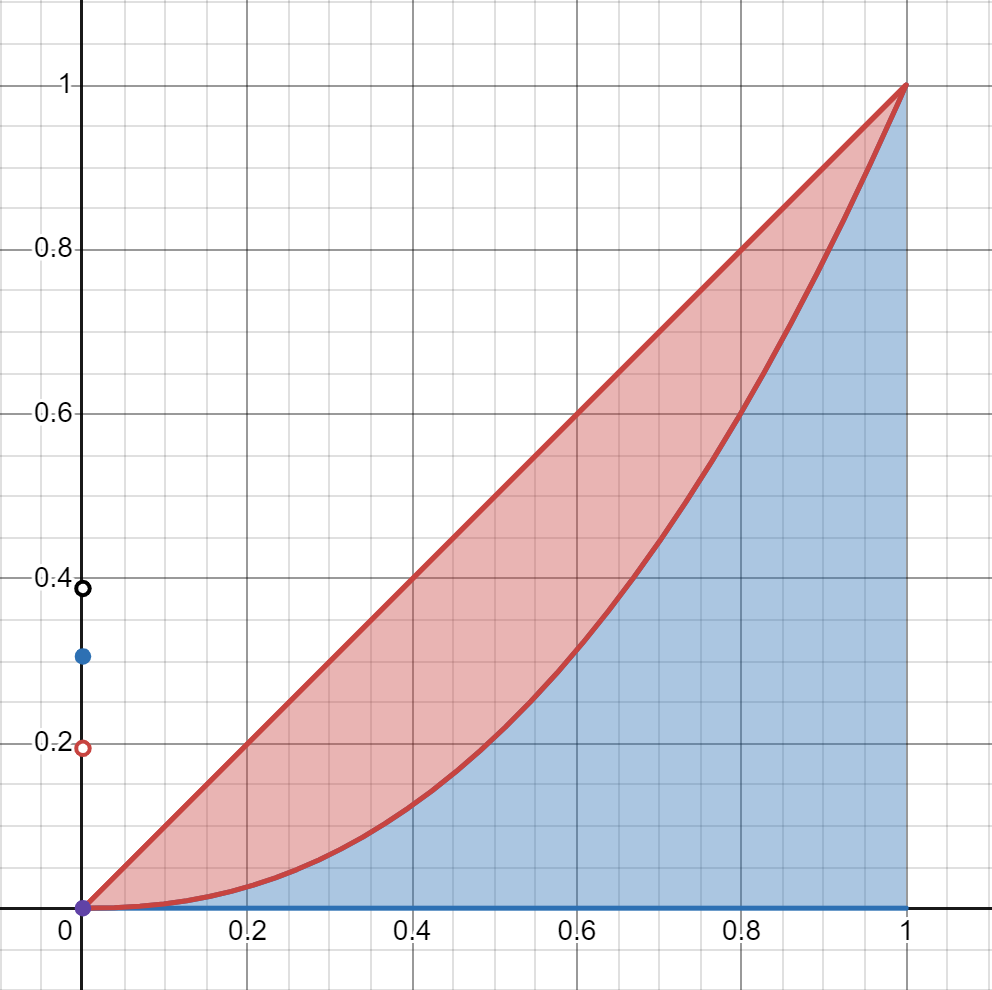
Netherlands Lorenz curve shows very low divergence from the perfect income equality line (45 degree line).
Brazil's Lorenz curve
Gini coefficient 52
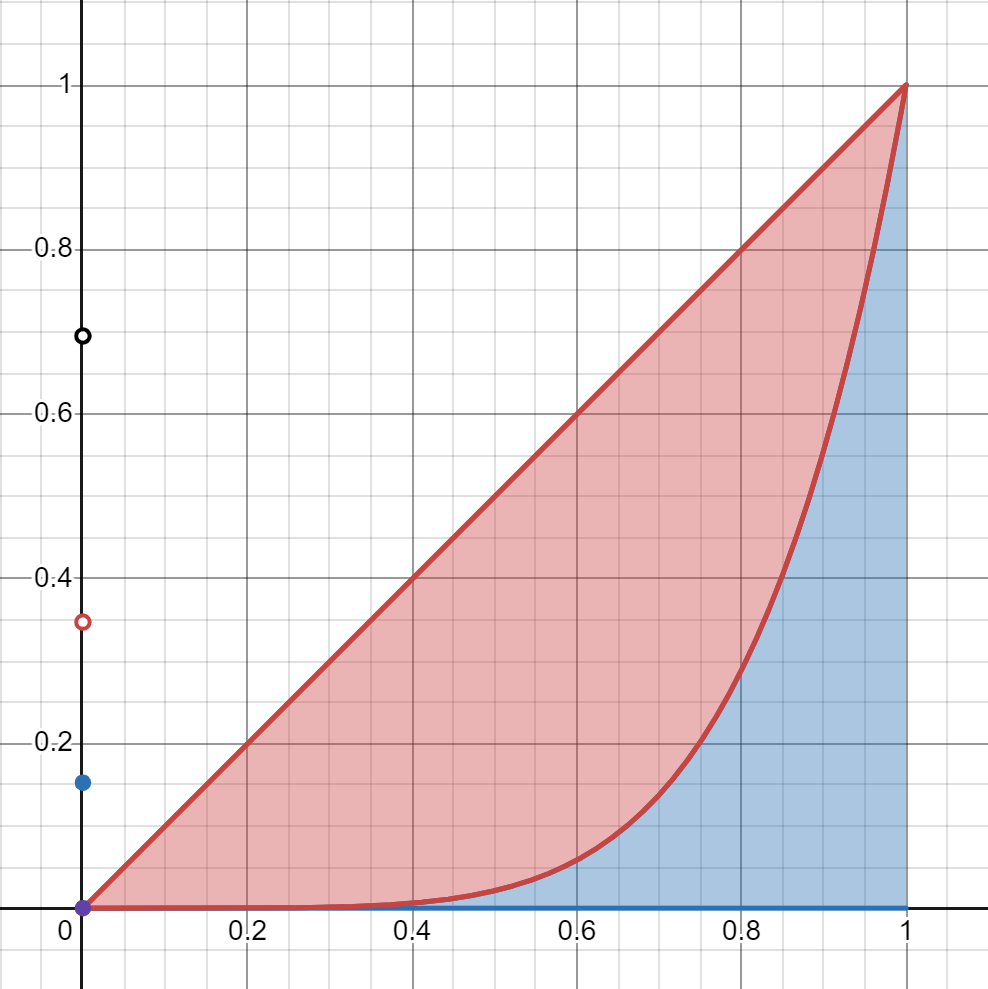
Netherlands Lorenz curve shows very low divergence from the perfect income equality line (45 degree line).
How does tax help?
Taxation is a large contributor to reducing income inequality, though not an exclusive tool or magic bullet! It is also worth stating that inequality has to be defined or understood before a proper analysis. The question infers ‘economic inequality’, which is GDP per capita (or to what extent the distribution in wealth is equal among a population).
However, this single indicator omits other aspects of inequality, like ‘intergenerational immobility‘!
However, we can answer this question using tax as the focus of improving inequality with a focus on the Netherlands and Brazil.
Any taxation should meet the basic principles of a good tax, set out by Adam Smith, which are 1) certainty 2 )convenience 3)equity and 4) economic. If taxes don’t meet these basic principles, a tax can be too difficult or costly to collect or may be rejected, like the Poll Tax in Britain in the 1990’s.
How does tax help inequality, specifically?
Taxation and its level is adapted each year with a country’s annual budget. Changes in the budget often feature tax changes to reflect the need for change.
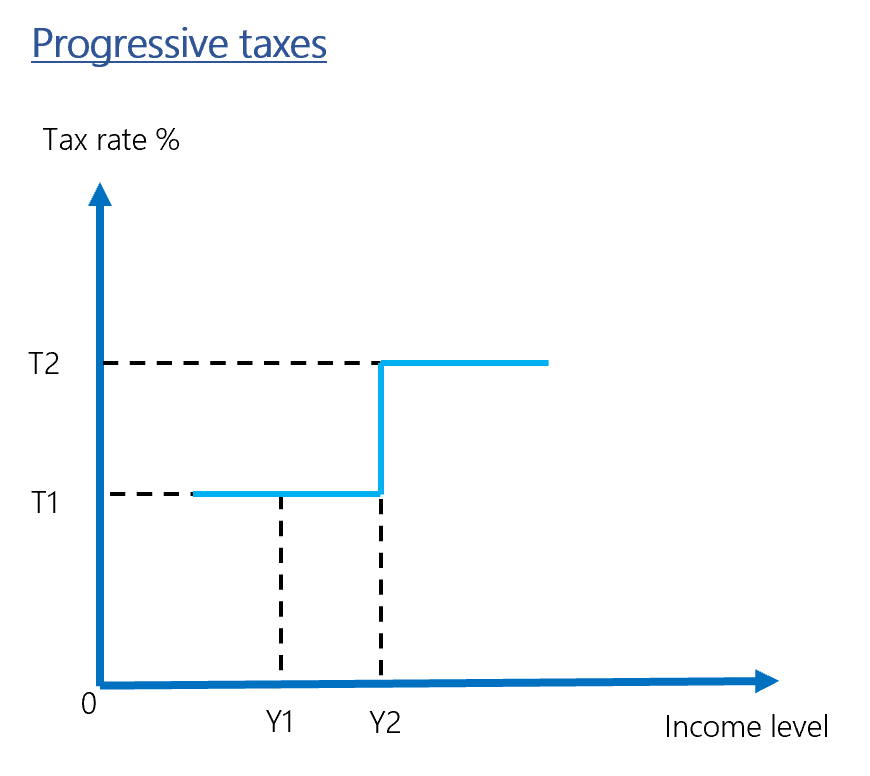
A country experiencing great economic inequality could alter their tax system in an effort to redistribute tax from wealthier individuals to poorer sections of society. This is achieved using a ‘progressive‘ tax system (diagram 2). A progressive system requires that higher income earners pay a progressively larger amount of tax as they earn more money (diagram 2)! Progressive tax systems determine the incidence by taxing income earners according to different bands of income.
For example, India has a top rate income tax of 42% above five crores (roughly $700,000). In 2023, India had 200 billionaires! Imagine that the super-rich did actually pay these taxes! You would be able to tax $1bn-$700,000 (999,300,000) at 42% * 200! Imagine all that money to redistribute into the Indian economy! That’s a lot of wealth re-distribution!
Indeed, a progressive tax system will yield a higher
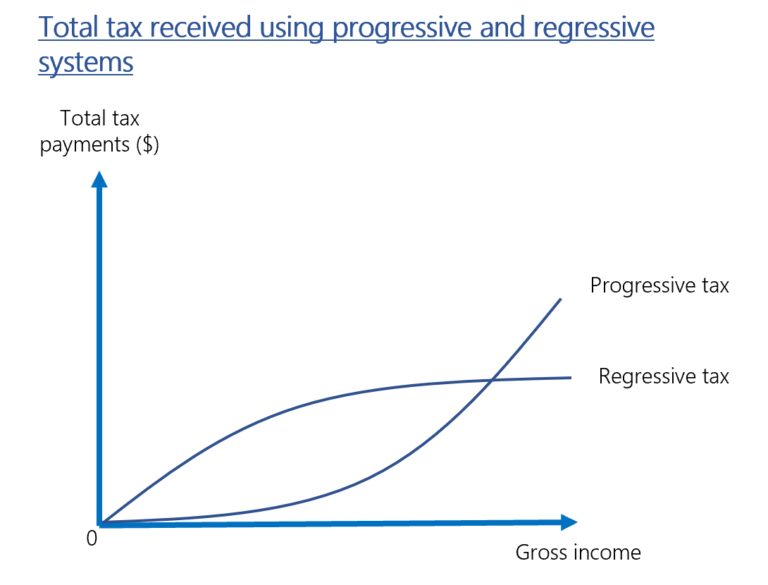
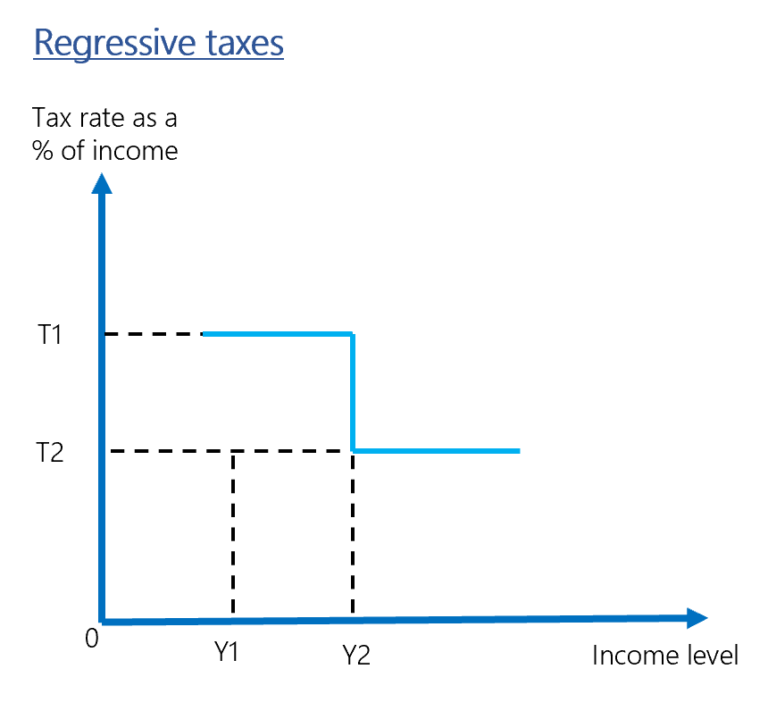
A progressive tax is the opposite of a ‘regressive’ tax system in which the tax burden falls disproportionately on the poorer segments of society (diagram 3)! Indirect taxes are typically regressive. For example, an increase in smoking taxes will tend to fall more heavily on poorer segments of society for two reasons:
1) any increase in tax is felt more significantly because the tax represents a greater proportion of income to a lower income earner
2) smoking is undertaken (in general) by poorer elements of society who are not always well educated or informed of the associated problems of smoking!
In fact, any indirect tax which falls on an activity that is disproportionately undertaken by poorer segments of society can be considered, ‘regressive‘!
Diagram 1 indicates that the total tax received using progressive tax can be higher, which is useful for governments to redistribute, but also to use for other aspects of economic management.


Drawbacks of progressive tax?
Can be politically unpopular.
May disincentivise entrepreneurship
May disincentivise individuals from trying to enter the job market.
Encourage business to locate elsewhere to lower tax countries.
Ultimately reduce the attractiveness of investment in a country!
Is tax the best method?
Implementing a progressive tax system is perhaps the single most effective method (excluding universal basic income) to reduce income inequality.
Many other methods are available as the list above implies, but they will all require funding.
Using a progressive tax system helps maintain a basic standard of living at the lower end of the income spectrum and provide social welfare, benefits and programmes to guarantee basic needs are met, lift individuals out of absolute poverty and limit the relative poverty of a country!
A successful progressive tax system can help fund other programmes that run in parallel that can support economic inequality, but other aspects of social inequality such as ‘generational inequality’!
Education and training (for example) is a complementary policy that could help break a historic chain of low education and low professional attainment.
In short, tax is the best method as long as:
1) Tax can be efficiently collected and is not successfully evaded
2) Tax is not too high as to distort economic incentives and behaviour
Conclusion?
Implementing a progressive tax system is perhaps the single most effective method (excluding universal basic income) to reduce income inequality.
Many other methods are available as the list above implies, but they will all require funding.
Using a progressive tax system helps maintain a basic standard of living at the lower end of the income spectrum and provide social welfare, benefits and programmes to guarantee basic needs are met, lift individuals out of absolute poverty and limit the relative poverty of a country!
A successful progressive tax system can help fund other programmes that run in parallel that can support economic inequality, but other aspects of social inequality such as ‘generational inequality’!
Education and training (for example) is a complementary policy that could help break a historic chain of low education and low professional attainment.
In short, tax is the best method as long as:
1) Tax can be efficiently collected and is not successfully evaded
2) Tax is not too high as to distort economic incentives and behaviour
Netherlands success 🙂
The Netherlands employs a progressive tax system, which is considered effective in reducing income inequality. The country is known for its comprehensive social security system, funded largely by these taxes, which includes health care, unemployment insurance, and various welfare benefits.
The Netherlands also focuses on high corporate taxes and tax compliance, reducing loopholes that allow evasion, which supports reducing income inequality and social equity.
The Netherlands is a successful example of how high tax can be consistent with public satisfaction and confidence in the system. Indeed, the Dutch are said to be ‘happy to pay high tax’ because of the raft of benefits that come with paying tax!
Brazil struggle 🙁
Brazil presents a contrasting case with significant income inequality (Gini coefficient of 53) despite having a somewhat progressive tax structure. One major issue is the inefficiency in tax collection and significant tax evasion which reduces tax collected and represents a missed opportunity to gather tax revenue to redistribute!
Brazil is criticized for having a large indirect tax framework (which is regressive), which hurts disproportionately a large number of poor people in Brazil (67 million are poor and 12.7million are classified as extremely poor)!
Despite high tax rates, the redistribution through public services is often marked by inefficiency and corruption, reducing the effectiveness of taxation in reducing inequality.
What can be concluded from Netherlands and Brazil in terms of tax?
The usefulness of tax depends on whether the system is accepted by the public, supported and can be collected (which depends on effective governance)! The effectiveness also depends on to what extent economic inequality already exists is!
Tax is perhaps the single biggest contributor to reducing income inequality, though should be used in parallel with other program such as education, useful minimum wages levels, housing support (and potentially others), all of which can be afforded and funded with progressive tax.
If these conditions can be met, then tax represents a low-cost method of reducing economic inequality and having the funds to tackle broader inequality issues such as, social inequality.



Do I really need Real World Examples (RWE's)?
If you want to score a level 7 in IB Economics, mastering theory isn’t enough—you need to apply it using Real World Examples (RWE’s). Whether you’re tackling a 15 mark essay or answering short-answer questions, your exam technique must demonstrate that you understand not just the theory but also how it works in real economies. The difference between an average response and a top-scoring answer? RWE’s that bring your arguments to life.
Think about it: a 15 mark essay on inflation that simply explains cost-push and demand-pull inflation is fine, but it won’t wow the examiner. However, an answer that references Turkey’s recent 50% interest rate increase to curb rapid inflation instantly makes your argument stronger. It shows the examiner you are engaging with the real world, not just regurgitating textbook definitions.
The Power of Real World Examples (RWE’s) in IB Economics
Stronger Analysis & Evaluation
A 15 mark essay requires evaluation. That’s tough if you only rely on theoretical models. When discussing protectionism, saying, “Trade wars can lead to retaliatory tariffs” is weak. Instead, referencing the US-China trade war makes your answer far more convincing.Better Contextualisation
IB Economics examiners love answers that show a clear link between theory and reality. If you’re writing about monetary policy, simply stating that “high interest rates reduce inflation” is basic. But if you mention the European Central Bank’s recent rate hikes to tackle inflation, it proves you understand how the concept plays out in the real world.More Engaging Essays
A good exam technique involves writing essays that stand out. Examiners read hundreds of essays—if yours is full of generic explanations, it’s forgettable. But if you integrate fresh, Real World Examples (RWE’s), your 15 mark essay becomes engaging and unique.
How to Use RWE’s for a Level 7 in IB Economics
- Keep up with the news—follow economic trends in the US, UK, China, and emerging markets.
- Be specific—mention actual statistics, policies, or events.
- Integrate naturally—don’t force examples in, but use them to support your analysis and evaluation.
Want a level 7? Real World Examples (RWE’s) are the key to success in IB Economics!
IB Economics Real-World Examples (RWEs): Where Theory Meets Reality
Welcome to the ultimate hub for IB Economics real-world examples (RWEs)—where theory meets reality. Whether you’re analyzing inflation, market failures, or global trade, real-world examples (RWEs) are essential for scoring top marks in IB Economics. Economics isn’t just about models and diagrams; it’s about understanding how policy decisions shape our daily lives, businesses, and entire countries. If you want to achieve a Level 7 and master exam technique, you must know a range of real-world examples (RWEs) to justify your answers—especially in Paper 3’s 10-mark policy recommendation question. Let’s explore how microeconomics, macroeconomics, and international trade play out in real time.
Microeconomics: The Power of Supply and Demand
Ever wondered why iPhones sell out instantly, or why concert tickets for artists like Taylor Swift skyrocket in price? This is IB Economics real-world examples (RWEs) in action. The law of supply and demand explains how firms price their products, why some brands hold monopoly power, and how government policy intervenes when markets become unfair. Rent controls in New York, price ceilings on energy in the UK, and minimum wage laws in Germany are all real-world examples (RWEs) of governments stepping in to correct market distortions. If you’re recommending policy solutions in the exam, strong exam technique requires backing up your analysis with real-world examples (RWEs).
Macroeconomics: Inflation, Interest Rates, and Government Debt
Macroeconomics isn’t just about GDP numbers—it’s about policies that impact millions of lives. Post-pandemic, we saw one of the best IB Economics real-world examples (RWEs) of inflation control. Central banks worldwide, from the U.S. Federal Reserve to the Bank of England, raised interest rates to slow down overheating economies. Countries like Argentina and Turkey struggle with hyperinflation, while Japan faces long-term deflation—both cases show why policy decisions matter. Meanwhile, government debt is skyrocketing. The World Bank reports that global debt levels are at record highs, forcing policymakers to rethink taxation and spending.
Will Debt Collapse Economies?
One of the biggest policy debates today is whether rising government debt will lead to economic collapse. The U.S. national debt has surpassed $30 trillion, and developing countries like Sri Lanka have defaulted on their loans. If debt spirals out of control, interest rates rise, currencies weaken, and economies crash. Is this the inevitable result of poor policy decisions? The International Monetary Fund (IMF) warns that unsustainable debt could trigger global recessions, making fiscal policy one of the most critical economic tools in the 21st century.
Trade: Globalization, Fast Fashion, and the Debt Trap
International trade connects the world, but it also creates economic winners and losers. The fast fashion industry thrives on cheap labor from developing countries, highlighting how firms use comparative advantage. But globalization isn’t always beneficial—some countries fall into a “debt trap,” borrowing billions for infrastructure projects they can’t repay. Sri Lanka’s recent debt crisis, where unsustainable borrowing led to an economic collapse, is a perfect IB Economics real-world example (RWE) of unsound trade and fiscal policy. Governments must balance trade openness with protective measures like tariffs and subsidies, making policy decisions critical for sustainable growth.
Why You Need Real-World Examples (RWEs) for Paper 3
If you want to ace IB Economics Paper 3, strong exam technique is essential—especially for the 10-mark policy recommendation question. Examiners expect students to justify their policy choices with concrete evidence. Whether it’s inflation control, government intervention, or trade protection, the best answers connect policy theory to real-world examples (RWEs). If you’re aiming for a Level 7, your exam technique must include well-structured, policy-driven answers with precise real-world examples (RWEs).
Keep exploring, keep questioning, and apply real-world examples (RWEs) to every concept you study. Economics is happening around you—understand it, and you’ll master IB Economics.