
IB Economics Real World Examples (RWE's)
Real world examples (RWE's) What's worse? Inflation or unemployment?
Discuss the view that high inflation or more significant than high unemployment [15]
A successful answer to this question doesn’t have to fall on one side or the other! The key to success is presenting a convincing argument that embeds real world examples (RWE’s) to support your view!
Problems of inflation

Redistributive Effects: Inflation disproportionately affects the poorer segments of society, those on fixed income, lower wages or savers. Those in receipt of welfare lose out!
Redistributive Effects: Conversely, borrowers may benefit since the real value of their debt decreases!
Uncertainty and Lower Investment: High inflation creates uncertainty postpone investment!
Damage to Export Competitiveness: Prices rise, exports are too expensive, balance of payments is affected, and jobs can be lost!
FDI falls: Due to a lack of confidence, investment falls!
Shoe Leather Costs: Higher inflation often leads consumers and businesses to spend more time and resources to avoid the costs of holding cash, which loses value rapidly (frequent trips to the bank and more time spent managing finances to minimize the impact of inflation).
Menu Costs: Frequently updating prices incurs costs for firms.
Wage-Price Spiral: High inflation can lead to a wage-price spiral, where workers demand higher wages to keep up with rising prices, products rise in price and so on and on!
Money ceases to function: In a serious case, money may cease to function as a medium of exchange as it holds no constant value due to constant changes in value!
Problems of unemployment

Loss of GDP: Unemployment / underemployment of resources (CELL) shifts the PPC curve inwards showing lost economic potential.
Loss of Tax Revenue: Lower earnings, lower tax revenue, lower potential spending and redistribution and chances of budget deficit increase!
Expenditure on Welfare: High unemployment increases demand for support, which increases strain on welfare services which are now more difficult to provide due to falling tax revenues!
Stress and Mental Health Issues: Unemployment often leads to increased stress, anxiety, and depression, which piques the need for additional healthcare.
Low Self-esteem: Prolonged unemployment can result in reduced self-confidence and self-worth. This may reduce employability and pique the need for health care!
Poverty: Without a steady income, unemployed individuals may face poverty, hunger, malnutrition, and in severe cases, homelessness.
Family Breakdowns: Financial and emotional stress caused by unemployment can lead to family disputes, separations, and divorces.
Crime and Anti-social Behavior: The frustration and deprivation caused by unemployment can lead to increased crime rates and anti-social behaviors like theft, alcoholism, and vandalism.
Social Deprivation: Concentrated unemployment can lead to widespread social problems (falling house prices) and contributing to broader social deprivation and increased crime rates!
What does unemployment look like, graphically?
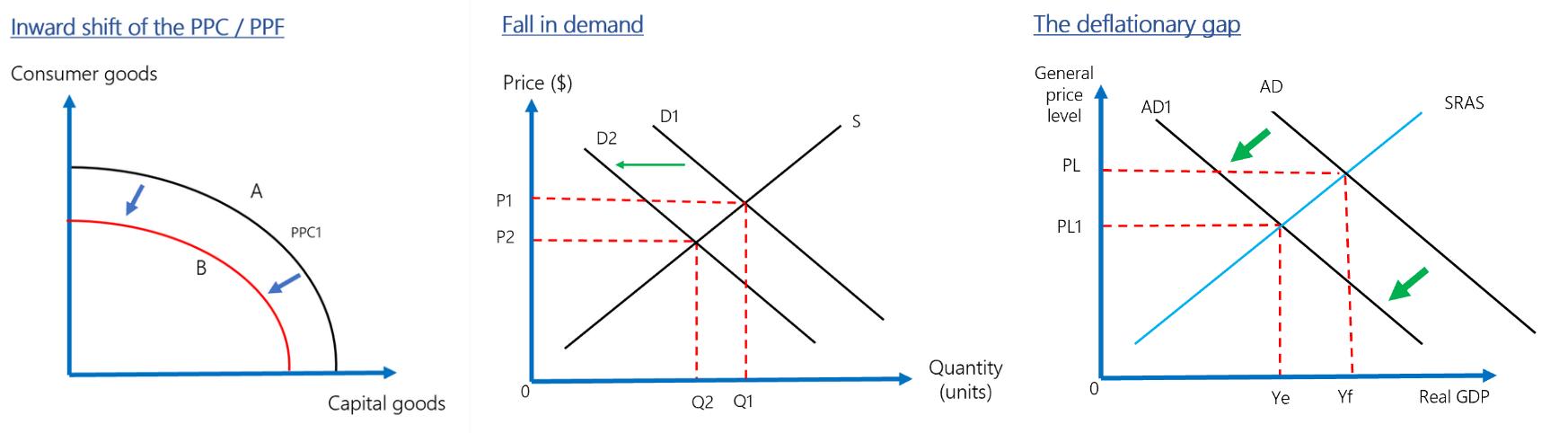
A fall in demand shifts in the PPC curve, indicating that components of a countries resource are underused! The productive capacity is not fully utilised, which is seen as a shift inwards on the PPC curve! The country could produce more, but the labour component is underemployed!
Lower employment leads to a fall in demand and ultimately a deflationary gap (using the AS/AD model) where the country earns (in GDP terms) less than it could where factors of production are fully utilised!


Which is worse? Inflation or unemployment?
It depends 😉
Which is worse could depend on what type of unemployment a country is experiencing!
Frictional U/E is regarded as inevitable and not too serious! Similarly, seasonal U/E can be predictable and as such can be planned around! However, structural U/E can be very serious, particularly if labour mobility is low and there is no obvious move to other areas of employment!
The answer may also depend on
- How long and how deep is the period of unemployment or the causes of the unemployment.
- How well can the unemployment be dealt with? For example, a successful economy running successive budget surpluses may be able and willing to invest in measures to remediate the problem, such as training and education, subsidies and tax cuts to support new industries.
- Economic problems tend not to be isolated! In this sense, how serious depends on other issues such as, ‘are their other serious underlying problems causing the unemployment’?
Real world Examples (RWE's): Turkey and South Africa

2024: Inflation 67%
Turkey is currently grappling with severe inflation, which is seriously impacting its economy. As of 2024, Turkey’s inflation rate has soared, with the Turkish Statistical Institute noting a rise to 67.07%
One of the main reasons for this high inflation is the depreciation of the Turkish lira, compounded by high energy and food prices. This situation is exacerbated by Turkey’s economic policies, which have often been out of step with conventional economic wisdom. For example, Turkey’s central bank kept interest rates unusually low for an extended period, which, contrary to President Erdogan’s intentions, contributed further to inflation
In response to the escalating crisis, Turkey’s central bank has significantly increased interest rates to 42.5% to try to stabilize the economy!
The economic outlook remains troubled with consumers being severely affected by high inflation rates, which causes problems particularly for low income and fixed income earners!

2024: Unemployment 40%
South Africa’s unemployment rate has climbed to an alarming 44.4% (the highest rate globally).
Structural challenges contribute to this issue. The nation’s educational system struggles to equip students with necessary skills, (affecting the semi-skilled and unskilled labor force).
The job market is further strained by tight labor laws that deter hiring and firing flexibility, worsening the unemployment situation.
Additionally, the high unemployment rate has significant economic and social implications. It exacerbates poverty and inequality, which are already severe due to South Africa’s historical and economic backdrop. High unemployment also stifles consumer spending, leading to reduced economic growth and putting additional strain on government resources to provide social aid. The social implications have been far reaching and continued to serious social and economic decline!
Conclusion?
There is no question that both inflation and unemployment are bad news for an economy!
It is hard to make a judgement on which is worse, but there are perhaps one or two generalisations that could be made!
Firstly, in the case of inflation in Turkey, tens of millions will be affected by the reduction in value of the lira. However, efforts by consumers can be made to buy cheaper goods and postpone purchases. Moreover, with harsh interests rates (up to 45%) this would suggest that spending will be controlled and that inflation may come down quickly, making the problem temporary!
By comparison, South Africa’s unemployment is of the most damaging structural nature! This is hitting 40% of the workforce and unfortunately, there is no policy that acts as swiftly to solve the problem of unemployment!
This means that the problem may persist for years to come, making unemployment potentially more serious in this case!



Why do I need Economics Real World Examples (RWE's)
In the IB Economics course, integrating Real World Examples (RWE’s) is essential for achieving high marks, especially when aiming for a level 7. Without IB Economics Real World Examples (RWE’s), your responses remain theoretical and abstract, limiting you to level 5 or 6 in most cases. This is because the IB Economics syllabus specifically requires students to demonstrate a deep understanding of economic theories and apply them to real-life situations. By weaving in Real World Examples (RWE’s), students can showcase their analytical skills and critical thinking, which are crucial for achieving top marks.
The IB Economics curriculum is designed not just to teach theoretical concepts but also to help students see how these concepts are relevant in the real world. IB Economics Real World Examples (RWE’s) give you the ability to contextualize theories and showcase your understanding of how they play out in actual economies. This not only strengthens your arguments but also provides you with a clear pathway to higher marks.
In this space, we examine real IB Economics past paper questions, integrating Real World Examples (RWE’s) to give you a practical edge. By engaging with past papers and adding RWE’s, you can build a portfolio of knowledge that will directly impact your exam performance. The more relevant examples you can bring into your writing, the stronger your answer becomes. This is particularly important for answering questions about policy applications, market failures, and economic growth, where real-world examples are necessary to explain complex economic theories.
To illustrate, let’s take a look at two short responses on inflation and unemployment:
Without Real World Examples:
“Inflation is the rise in the general price level over time. This can be caused by demand-pull or cost-push factors. High inflation can lead to decreased purchasing power and can harm savings and investment. Governments often try to control inflation using monetary and fiscal policy tools.”
With Real World Examples (RWE’s):
“Inflation is the rise in the general price level over time. For example, in 2021, many countries, including the US and the UK, experienced a sharp increase in inflation due to supply chain disruptions caused by the COVID-19 pandemic. This was largely a cost-push factor, where the increase in the cost of raw materials, like oil, drove up production costs. Additionally, demand-pull inflation occurred as governments around the world injected stimulus money into their economies, increasing demand. The US Federal Reserve responded by signaling future interest rate hikes to control inflation, much like they did after the 2008 financial crisis. By connecting theory to events like these, we can better understand how inflation impacts real economies.”
As you can see, the second example is much richer in content. It ties theoretical concepts directly to global events, demonstrating a comprehensive understanding of IB Economics. This not only strengthens the answer but also shows the examiner that you can apply your knowledge to real-world situations—something that is heavily emphasized in the syllabus.
In conclusion, integrating IB Economics Real World Examples (RWE’s) into your answers is crucial for elevating your work from theoretical explanations to well-rounded, analytical essays. By doing so, you are not only meeting the syllabus requirements but also setting yourself up for success in achieving top marks in the IB Economics course.