
IB ECONOMICS Real world examples (rwe's)

IB-Economics-Real-World-Examples-RWE's-Farmyard-Burp-Tax-New-Zealand
IB-Economics-Real-World-Examples-RWE's-Famyard-Burp-Tax-New-Zealand

Need some real-world examples for IB Economics?

IB Economics RWE’s: Pricing Pollution with New Zealand’s Farmyard Burp Tax

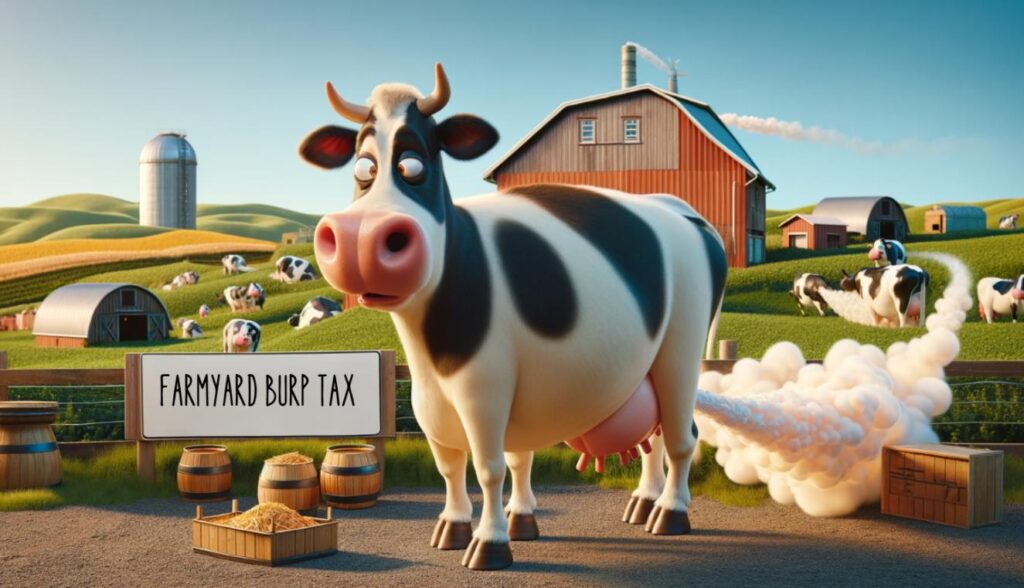
In IB Economics, the best answers come when students go beyond theory and show how governments respond to real-world economic problems. That’s where IB Economics real world examples (RWE’s) are so useful. New Zealand’s Farmyard Burp Tax—a bold attempt to price agricultural methane emissions—is a fascinating IB Economics RWE under the lens of demerit goods. While livestock products like beef and milk aren’t traditionally seen as harmful, the methane released through “burps” during digestion contributes significantly to climate change. This policy provides a creative and controversial response to one of the most pressing environmental externalities.


Farmyard Burp Tax (New Zealand): Demerit Goods Policy

New Zealand’s Farmyard Burp Tax is a unique example of a demerit goods policy. It seeks to reduce the overproduction and overconsumption of methane-intensive agricultural goods by internalising their negative externalities through taxation and regulation.


Background Information 

In 2022, New Zealand proposed a policy to tax greenhouse gas emissions from livestock, including methane released from cow and sheep burps. Agriculture accounts for nearly half of New Zealand’s emissions, with methane from ruminant digestion being a major contributor. The tax—set to be implemented by 2025—targets emissions at the farm level and aims to incentivise lower-emission practices. The policy is part of New Zealand’s broader effort to meet climate targets under the Paris Agreement. It sparked heated debate among farmers, environmentalists, and economists, but positioned New Zealand as a global leader in confronting agricultural emissions head-on.


Economic Theory and Policy Objectives

In IB Economics, demerit goods are not only harmful to individuals but also to society—especially when their production or consumption results in negative externalities. In this case, methane emissions from agriculture contribute to climate change, imposing costs on others without being reflected in market prices. The Farmyard Burp Tax aims to internalise the externality by placing a Pigouvian tax on methane emissions. This shifts the supply curve leftward, raising prices and reducing output toward a more socially optimal level. The policy also encourages innovation in animal feed, breeding, and farming techniques to reduce emissions per unit of output.


Policy Evaluation 

The policy represents a bold step toward addressing agricultural emissions, and it has already incentivised research into methane-reducing feed additives and genetic innovations. However, it faces significant opposition from New Zealand’s powerful farming sector, which argues the tax will reduce international competitiveness and disproportionately hurt rural communities. There’s also a risk of carbon leakage—where production shifts overseas to countries with looser regulations. Politically, it remains contentious, and its success may depend on how revenues are recycled back into the agricultural sector. Still, it’s a globally significant example of a country attempting to confront environmental harm from a major domestic industry.


Learn with IB Economics RWE’s 

This policy was selected for IB Economics students and teachers looking to apply theory to meaningful real-world situations. New Zealand’s Farmyard Burp Tax is a creative IB Economics RWE about demerit goods, externalities, and government intervention. These examples bring life to your Paper 1 essays and IA evaluations. You don’t need to memorise every policy—but knowing a few strong IB Economics real world examples like this will build your confidence and help you write answers that are analytical, insightful, and memorable.


IB Economics RWE Scorecard: Farmyard Burp Tax (New Zealand)

CategoryScore (/100)Symbol Representation
💸 Cost Effectiveness 81💸💸💸💸💸
✅ Policy Success 77✅✅✅✅✅
👍 Public Support 71👍👍👍👍
♻️ Long-term Viability 74♻️♻️♻️♻️
📊 Macroeconomic Impact 59📊📊📊
 

Got any other useful sites or pages for IB Economics?

A complete set of IB Economics teaching / revision resources: https://ibmonkeybusiness.site/ib-economics-resources/

Key terms / vocabulary list / glossary for IB Economics: https://ibmonkeybusiness.site/ib-economics-key-terms-glossary/

Want to broaden your horizons with some wider reading?: https://www.bbc.com/news/business/economy

Here’s a link to another great partner website: https://thecuriouseconomist.com/


IB Economics Real-World Examples (RWEs): Where Theory Meets Reality

Welcome to the ultimate hub for IB Economics real-world examples (RWEs)—where theory meets reality. Whether you’re analyzing inflation, market failures, or global trade, real-world examples (RWEs) are essential for scoring top marks in IB Economics. Economics isn’t just about models and diagrams; it’s about understanding how policy decisions shape our daily lives, businesses, and entire countries. If you want to achieve a Level 7 and master exam technique, you must know a range of real-world examples (RWEs) to justify your answers—especially in Paper 3’s 10-mark policy recommendation question. Let’s explore how microeconomics, macroeconomics, and international trade play out in real time.

Microeconomics: The Power of Supply and Demand

Ever wondered why iPhones sell out instantly, or why concert tickets for artists like Taylor Swift skyrocket in price? This is IB Economics real-world examples (RWEs) in action. The law of supply and demand explains how firms price their products, why some brands hold monopoly power, and how government policy intervenes when markets become unfair. Rent controls in New York, price ceilings on energy in the UK, and minimum wage laws in Germany are all real-world examples (RWEs) of governments stepping in to correct market distortions. If you’re recommending policy solutions in the exam, strong exam technique requires backing up your analysis with real-world examples (RWEs).

Macroeconomics: Inflation, Interest Rates, and Government Debt

Macroeconomics isn’t just about GDP numbers—it’s about policies that impact millions of lives. Post-pandemic, we saw one of the best IB Economics real-world examples (RWEs) of inflation control. Central banks worldwide, from the U.S. Federal Reserve to the Bank of England, raised interest rates to slow down overheating economies. Countries like Argentina and Turkey struggle with hyperinflation, while Japan faces long-term deflation—both cases show why policy decisions matter. Meanwhile, government debt is skyrocketing. The World Bank reports that global debt levels are at record highs, forcing policymakers to rethink taxation and spending.

Will Debt Collapse Economies?

One of the biggest policy debates today is whether rising government debt will lead to economic collapse. The U.S. national debt has surpassed $30 trillion, and developing countries like Sri Lanka have defaulted on their loans. If debt spirals out of control, interest rates rise, currencies weaken, and economies crash. Is this the inevitable result of poor policy decisions? The International Monetary Fund (IMF) warns that unsustainable debt could trigger global recessions, making fiscal policy one of the most critical economic tools in the 21st century.

Trade: Globalization, Fast Fashion, and the Debt Trap

International trade connects the world, but it also creates economic winners and losers. The fast fashion industry thrives on cheap labor from developing countries, highlighting how firms use comparative advantage. But globalization isn’t always beneficial—some countries fall into a debt trap,” borrowing billions for infrastructure projects they can’t repay. Sri Lanka’s recent debt crisis, where unsustainable borrowing led to an economic collapse, is a perfect IB Economics real-world example (RWE) of unsound trade and fiscal policy. Governments must balance trade openness with protective measures like tariffs and subsidies, making policy decisions critical for sustainable growth.

Why You Need Real-World Examples (RWEs) for Paper 3

If you want to ace IB Economics Paper 3, strong exam technique is essential—especially for the 10-mark policy recommendation question. Examiners expect students to justify their policy choices with concrete evidence. Whether it’s inflation control, government intervention, or trade protection, the best answers connect policy theory to real-world examples (RWEs). If you’re aiming for a Level 7, your exam technique must include well-structured, policy-driven answers with precise real-world examples (RWEs).

Keep exploring, keep questioning, and apply real-world examples (RWEs) to every concept you study. Economics is happening around you—understand it, and you’ll master IB Economics.