One of the first things worth knowing is that when one country purchases from another, essentially two things have to happen!
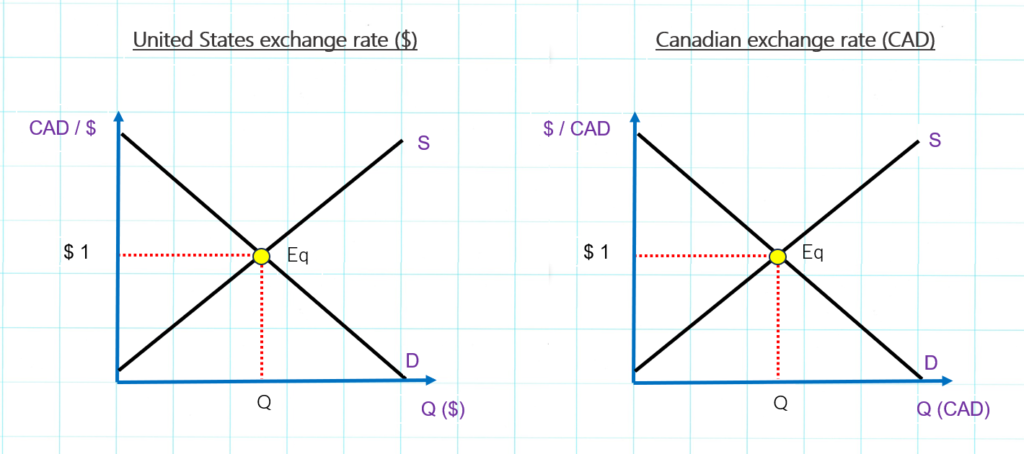
So… it’s worth thinking about the issue in terms of a pair of supply and demand diagrams!
In this diagram, you have trade between The USA (on the left) and Cananda (on the right).
Imagine that an American wants to buy (import) some Canadian Maple Syrup!
For that transaction to take place, two things need to happen! First, the American must exchange US dollars (sell US dollars on the foreign exchange market). Second, he now has to buy Canadian dollars (CAD).
So, this gives you a pair of shifts on the first diagram!
Question: What do you think those shifts would be? Maybe have a think before you look at the outcome or answer diagram below!
The first is to increase the supply of US dollars (a rightwards shift). This happens on the US dollar diagram (below, left). The second is the
SCENARIO #1 — RELATIVE INTEREST RATES
Background: The interest rate rises to 15% in the USA 🇺🇸, but remains at 5% in Canada 🇨🇦. Investors can potentially earn a higher return by moving their savings to the USA.
Question(s):
Which currency is bought?
Which currency is sold?
Which curves shift (and in which direction) in the foreign exchange market?
Which currency appreciates and which currency depreciates?
SCENARIO #2 — SPECULATION
Background: Speculators believe the Japanese Yen ¥ 🇯🇵 will increase in value in the near future. This forecast is also matched by an expectation that the $USD 🇺🇸 will fall in value.
Question(s):
Which currency is bought?
Which currency is sold?
Which curves shift (and in which direction) in the foreign exchange market?
What happens to their exchange rate?
SCENARIO #3 — FOREIGN DIRECT INVESTMENT (FDI)
Background: American businesses dramatically increase their FDI into the UK 🇬🇧. They build factories, buy machinery and employ British workers. Much of this spending must be made in £GBP.
Question(s):
What must American businesses do before making these investments?
Which currency is bought?
Which currency is sold?
What happens to the value of each currency?
SCENARIO #4 — FDI GOES THE OTHER WAY
Background: British businesses suddenly begin investing heavily in Canada 🇨🇦, building factories and buying Canadian businesses.
Question(s):
Which currency will British firms need to obtain?
Which currency will they supply?
How will this affect the £GBP and $CAD exchange rate?
SCENARIO #5 — RISING INCOMES ABROAD
Background: Incomes in China 🇨🇳 rise significantly. As Chinese consumers become wealthier, they buy considerably more British products, including British clothing, cars and financial services.
Question(s):
Why would this create demand for £GBP?
What happens to the supply of RMB ¥?
What happens to the value of both currencies?
SCENARIO #6 — FALLING INCOMES ABROAD
Background: The USA 🇺🇸 enters a recession and American household incomes fall. Americans consequently buy fewer goods imported from Japan 🇯🇵.
Question(s):
How would this affect American demand for ¥Yen?
How would this affect the supply of $USD on the foreign exchange market?
What happens to the relative value of the two currencies?
SCENARIO #7 — UK COMPETITIVENESS
Background: British businesses become significantly more competitive 🇬🇧. Productivity improves, production costs fall and British products become more attractive to American consumers.
Question(s):
If Americans buy more British products, what happens to demand for £GBP?
What happens to the supply of $USD?
What happens to the exchange rate?
SCENARIO #8 — LOSS OF COMPETITIVENESS
Background: Production costs in the UK 🇬🇧 rise much faster than in Europe 🇪🇺. British products become relatively expensive and European consumers buy fewer British exports.
Question(s):
How will this affect demand for £GBP?
How will this affect the supply of €EUR?
What happens to the value of the pound relative to the euro?
SCENARIO #9 — TWO THINGS HAPPEN (Reinforcing Pressures)
Background: Interest rates rise substantially in the UK 🇬🇧, attracting foreign investors. At the same time, British products become more competitive and exports to the USA 🇺🇸 increase.
Question(s):
Do these events push the £GBP in the same direction or opposite directions?